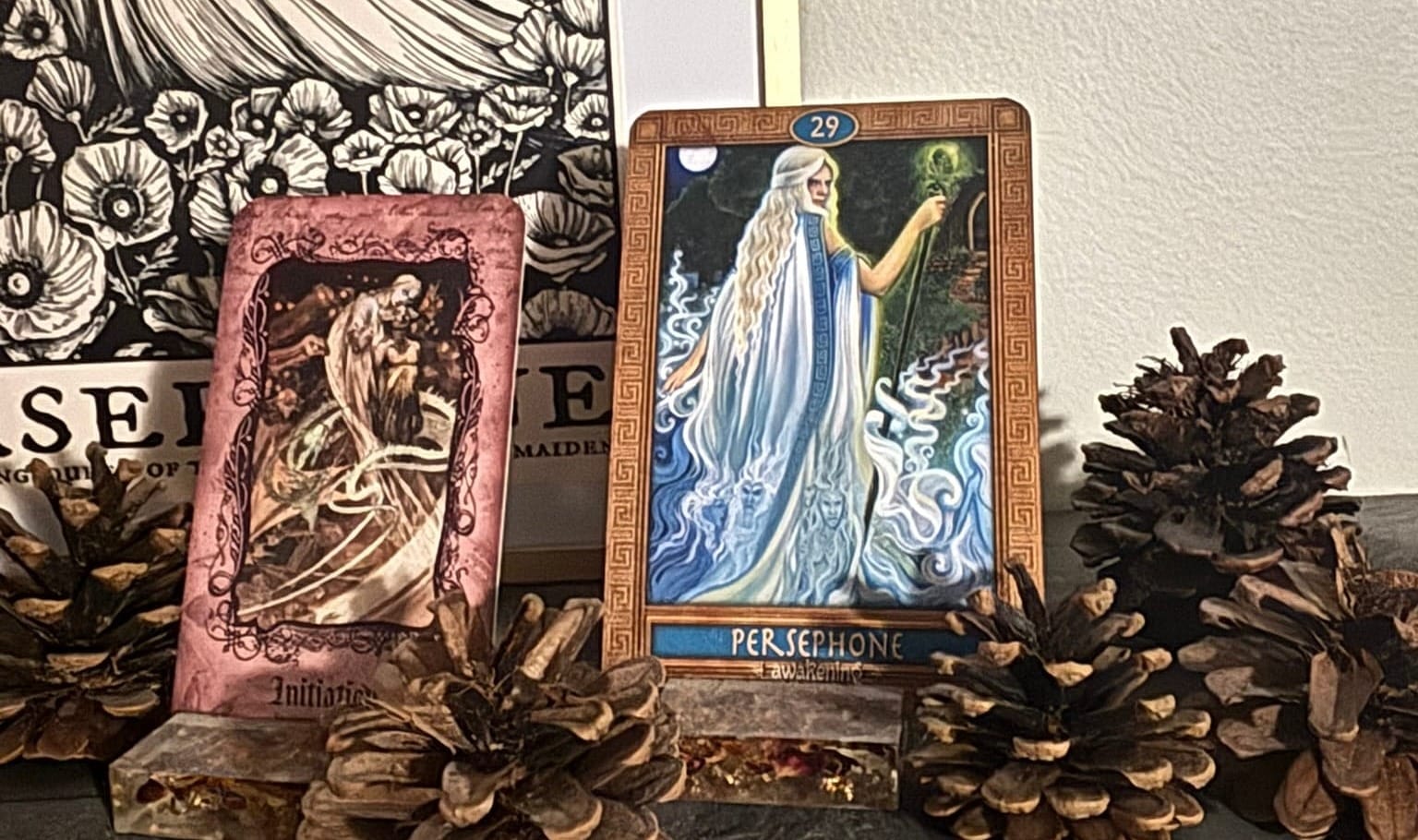
Persephone


*Trigger Warning: This post mentions themes of rape and sexual assault.
I honestly have no idea where this post will take me, but I’m just gonna let it happen.
So, I had a rather long and full day. I learned quite a bit about myself, and about how to potentially handle anxiety and panic attacks in the workplace. I have a strategy to test out, at least, and more possible strategies on the way.
I then went and got my teeth cleaned after maybe three (?) years of skipping out on the dentist (yuck!). That was an experience, to say the least.
When I got home I immediately jumped on my laptop and started digging. I wanted to write a post about my goddess, my Persephone, but something was bothering me. I had listened to an episode of Witch Wednesdays in the car on the way to one of the appointments earlier in the day. It had been a very interesting episode about the new book by Jenna Matlin called The Tarot Book of the Dead. I very much enjoyed everything the author had to say about her book, until about minute twenty-five, when she explained why Persephone was not included in the book at all. Both my heart and mind did a kind of double-take, hearing that. Persephone, left out of a book about the dead? It felt wrong to me and I honestly felt a bit hurt and offended on the Queen of the Dead’s behalf.
Now, I want to say, first of all, that I get Jenna’s point, on one level. Persephone’s main original source, the Homeric Hymn to Demeter, does not afford the goddess much in the way of outright agency. Most of it does not even follow her experiences, instead following her mother, Demeter, who searches frantically over the whole earth looking for her lost daughter.
Persephone is also, as I've shared previously, a very important goddess for me, so I realize, too, that I’m not without my own bias on the topic.
However, I am not sure we can fully judge a goddess by her source material. Don't get me wrong- I studied Classical Studies in college and I absolutely understand the importance of a primary source. I think, honestly, it depends on what we are using the source for, what it is representing for us.
For me, the Homeric Hymn is simply the oldest, most complete, source that survives to this day concerning Persephone's myth. That does not make it conclusive, however, by any stretch. The Ancient Greeks passed down their myths through a rich oral tradition for a long time before they ever started to write them down. This is important to note, in my opinion, because not everything that was felt or thought about the goddess, even on a community-level, managed to survive in any kind of text.
I do not think the Homeric Hymn encompasses the entirety of Persephone's energy or even the entirety of her story, at all. To me, she is much more than those few words that happened to get passed down to us from a lucky medieval manuscript.
I will also point out that this particular source was most likely written by a man, both in its original ancient Greek form (meaning the words that were copied down by the medieval monk) and in its medieval, copied down, form (which was also in Greek). The original writer remains anonymous, but most writers back then were men, so it stands to reason that the odds of a woman authoring this Hymn are slim. Not to mention, even if a woman did happen to write it, she would have been writing from the perspective of someone deeply embedded in a society that was even more patriarchal than our own.
I want to say that, for me, goddesses are not limited to their original source material, anyways. None of them are. They are divine beings, daimones, and they live and change just like everything else in the cosmos. I think, then, that the more modern feminist interpretation of Persephone can be considered just as valid as the Ancient Greek original.
I truly think the only way to actually know the essence of who Persephone is would be to speak with her oneself.
I have not spoken much to Persephone, I will openly admit this. While I want to speak with her very badly, I do not know if I am ready to put consistent time and effort into a relationship with any god or goddess at the moment. There is just a lot going on in my life and I do not want to promise her time and then fail to follow through. So, I have kept my distance. Even so, her presence is all around me on a daily basis, whether I speak to her directly or not.
I may not have the experience of speaking to Persephone quite yet, but I do feel like I know her, at least on some level. I also feel a kinship with her that I have not yet felt with any other deities.
That being said, I went back and re-read the Homeric Hymn to Demeter, to try and parse out my actual thoughts on this particular primary source.
The 19-20 lines from Gregory Nagy's translation of the Homeric Hymn are very clear:
"He seized her against her will, put her on his golden chariot,
And drove away as she wept."
Persephone’s story- being stolen by her uncle and brought to the Underworld against her will- is dark. I think that is a good portion of why I feel close to her, though. In her original myth she did not get a choice. I did not get a choice in my Underworld journey, either.
I want to say this disclaimer real quick - I do not want to downplay anyone’s real lived experiences with sexual assault or rape. These are horrific traumas that no woman should ever have to experience. Period.
I have never been raped or assaulted (and I thank the gods above for this). And what I’m going to say next is not meant to downplay or compete with that trauma- I realize what I’m going to be talking about is quite different.
At the same time, I truly believe that sometimes we as humans do go on different variations of the archetypal "Underworld journey," even as our physical bodies remain in the land of the living. If we did not ever have these metaphorical journeys, we would never really grow. I believe, as souls, we all chose our various earthly lifetimes to be able to learn and grow from what we experience within them. So, I liken my experience with OCD to my soul's version of an Underworld journey. I was pulled against my will into a very dark and unfamiliar place. I relate to Persephone because that is the nature of trauma - we do not have control over when it happens or where it takes us. However, we can control how we respond.
I am including this short excerpt from Gregory Nagy's translation, as well, so that I can then discuss it:
"Swiftly he [Hades] gave an order to bright-minded Persephone.
'Go, Persephone, to your mother, the one with the dark robe.
Have a kindly disposition and thūmos [passion] in your breast.
Do not be too upset, excessively so.
I will not be an unseemly husband to you, in the company of the immortals.
I am the brother of Zeus the Father. If you are here,
You will be queen of everything that lives and moves about,
and you will have the greatest tīmai [honors] in the company of the immortals.
Those who violate dikē [justice] will get punishment for all days to come
those who do not supplicate your menos [mind, spirit, vigor] with sacrifice, performing the rituals in a
reverent way, executing perfectly the offerings that are due.'
So he spoke. And high-minded Persephone rejoiced."
I want to break down my personal interpretation of these lines for you. So, in these lines, Hades is indeed giving Persephone an order. This is obviously problematic and difficult to read, as someone who loves and cherishes Persephone and believes wholly in her having her own agency. Yet, people in positions of power give orders all the time. Hades, I believe, knows what he is doing. He is trying to manipulate the situation as best as he can. At the same time, he clearly says, later, "If you are here," which tells me that he is actually a bit worried. He does not know if Persephone will choose to obey him or not, once she is back on Olympus with her mother.
So, he sweetens the deal. He gives her sovereignty over everything in the Underworld, assures her that the other immortals will have to give her honors, as well, and finally, promises that anyone who does not respect her will be appropriately punished.
These are all given to her, if she chooses to stay, and I will argue again that the fact that Hades is the giver in this particular myth does not matter so much. She still ends up with all of these things at the end of this version of her story.
I also want to talk about this line:
"And high-minded Persephone rejoiced."
This line can be taken two different ways- it is rather ambiguous, the way it was translated. (Honestly, the most accurate way to analyze this Hymn would be to read it in Greek, but my ancient Greek language skills are currently very rusty, so I have to rely on this well respected English translation.) Is she rejoicing because of receiving these gifts from Hades, or is she rejoicing that she gets to return and see her mother again? I would be willing to wager that her response includes a bit of both.
This is the last excerpt I will explore with you, today:
"Swiftly she set out, with joy. But he [Hādēs]
gave her, stealthily, the honey-sweet berry of the pomegranate to eat,
peering around him. He did not want her to stay for all time
over there, at the side of her honorable mother, the one with the dark robe."
This is all we know about the pomegranate seeds, according to this Hymn. The lines that would have detailed the act of her actually eating the seeds is damaged, torn in the only extant manuscript we have. Therefore, we do not really know how Persephone came to eat those pomegranate seeds. All we know is that Hades gave them to her in a sneaky way.
This is probably where the sticking point is for me with Jenna’s comment. Persephone does accept sovereignty that is given to her by Hades, and she does sort of get bound into what could be seen I suppose as a bit of a “prison sentence.” I want to point out a couple of things, though. Sovereignty is sovereignty. She is still a ruler, a Queen, of a vast kingdom. Does it truly matter that this power was gifted to her by a god (in one version of her myth)?
Normally I would argue- “Yes, of course it matters!” But I am honestly not so sure it does, when I step back and really think about it. Hades gives Persephone the sovereignty after he agrees to release her back to the upper world and before she eats the pomegranate seeds. That means, in that moment, Persephone is free to leave or stay.
In the Homeric Hymn, Hades does use trickery to sneak pomegranate seeds to Persephone. However, I’m not sure the trickery was meant for Persephone. Hermes was also present. The rule that once one consumed the food of the dead they were confined to the Underworld was a divine rule, widely known. Even if the pomegranate seeds "sneakily" appeared in Persephone’s hands, my argument is that she knew she was eating them. She also knew the fruit was an Underworld food. I think the trickery from Hades was aimed at Hermes- not Persephone. Persephone knew what she was doing when she ate those seeds, therefore, which means she did choose to be bound to the Underworld, despite what she later says to her mother.
Knowing about the seeds and eating them anyway gives Persephone agency.
Persephone’s abduction and trauma does not make her lesser than any other goddess. She went through something immensely difficult, and survived. Not only did she survive, she became sovereign over the whole realm associated with it. I don’t think we give Persephone enough credit, therefore. She survived, and that is enough. We, as survivors of hard things, are enough. So what if the dark circumstances that shaped us gave us new parameters that changed our lives around? Trauma does change a person- this is true. Yet, how we choose to emerge on the other side of it can make us infinitely stronger, as well.
To me, Persephone is the eternal Queen of the Underworld. To exclude her from a book about the dead is a mistake, in my opinion. The fact that she was assaulted in and of itself does not mean her story should be hidden or removed. On the contrary, we should tell it more. We need to look at the ugly in our lives and our societies. Looking at the hard things takes some of their power away. Persephone is not made lesser or damaged or made ugly because she was assaulted. Her unique energy should be respected, not disregarded or avoided.
I mentioned my busy day, earlier. Part of why Jenna's comment really struck a chord with me was because of how empowered I feel when I think of Persephone and her story. One of my appointments today was with a career coach. We were working on a plan so that I can be more successful handling anxiety attacks as they come, especially if they come to me while I'm at work.
One step is recognizing in my body when the anxiety starts to manifest. I feel it as a tightness in my chest, first. Then my breathing changes, becoming rapidly more elevated and more shallow.
The next step we established was thinking back to a time when I felt empowered. "Like Wonder Woman," my career coach said. Well, the only time I have ever felt anywhere close to feeling like a "Wonder Woman" was after I had survived my initial ordeal with OCD and realized that I could handle any more OCD that came my way. It took a lot of time to be able to look at the experience from enough distance that I could feel pride in myself for handling it- for surviving it. And yet, it is a gift to be able to look back on it and remember:
I did that, I survived that experience.
Persephone is a big part of that feeling, that pride, for me. She represents someone who survived trauma and rose above it, someone who became a fearsome and powerful version of her truest self once she chose to survive the ordeal placed in front of her. I mentioned this to my career coach, and we created something of a "quick reference-" a phrase I can say to myself to immediately anchor myself in Persephone's dread queen energy:
Six seeds.
That was the phrase I chose.
At the time, it was simply the phrase that my intuition brought forward for me. I said it to my career coach, who wrote it on my goals board with enthusiasm. For me, Persephone eating the pomegranate seeds represents a choice - her choice - to become Queen of the Underworld. Eating the six pomegranate seeds is the moment she embodies her role as the true queen of the darkness. It is the moment she became sovereign over the unfamiliar, frightening place she had been forced to reside within.
The truth is, once she got there, she could never really return to Olympus unchanged- not without remembering the trauma, and not without experiencing an internal shift as a result of going through it. I think Persephone knew that. I think she understood the implications of her experience, what it meant for her future. Instead of trying to return to how she was before, she embraced the difficult things she went through, took them and refused to shrink as a result of them. This is the energy of Persephone, as I understand it.
I want to take this space to thank Persephone. Her story, traumatic and dark as it may be, provides an anchor for me to be able to say yes- like Persephone, I survived. I am strong, and I can be a queen, too.
This may not be everyone's reaction to Persephone's story, and that is okay, too. I know there is a lot of room for interpretation, as well as for personal experience, in how we see different deities. But this is my personal perception of Persephone. This is how I feel when I think about her, and when I engage with her energy.
Thank you, barn witch, for reading and sharing this meditation of who Persephone is to me.